LaserAway
- 4.7
- Rating
- 10.00K
- Installs
- Free
- Price

 Analysis by App-foxy
LaserAway is a beauty app from LaserAway Medical Group, INC. that puts the company’s services in a more convenient mobile setting. I approached it as someone deciding whether an app would genuinely help with planning aesthetic treatments, rather than expecting it to replace professional advice. My overall impression is that it works best as a practical companion for people already considering LaserAway, while its value is more limited for someone simply browsing general beauty information.
The app is free to use and carries an Everyone content rating, which makes it easy to try without committing money upfront. It belongs to the beauty category, but it is important to understand what that means here: this is not a makeup editor, skincare tracker, or virtual makeover tool. Its purpose is tied to LaserAway’s own treatment experience, so the useful question is not whether it offers every kind of beauty feature, but whether it reduces friction around researching and managing interest in that provider.
How LaserAway feels in everyday use
In my experience, the strongest reason to keep an app like this installed is convenience. Beauty treatments often involve several small decisions before a visit: remembering what you wanted to ask, checking the next step, and keeping your plans organized around work or family commitments. A dedicated mobile experience can make that process feel less scattered than switching between a browser, notes app, email, and phone calls.
You May Also Like

 AccuWeather: Weather Radar
AccuWeather Review: A Quick, Clear Forecast for Everyday Decisions
For everyday plans, the best forecast is the one you can understand quickly. AccuWeather makes rain timing, radar, and local conditions easy to act on, with a few trade-offs.

 Hill Climb Racing
Why Hill Climb Racing Still Turns Crashes Into One More Run
A tiny car, a bumpy hill and one more upgrade: Hill Climb Racing keeps resurfacing because its simple chaos makes every near-miss feel personal.

 AliExpress - Shopping App
AliExpress Makes Global Shopping Feel Personal, but Shoppers Bear the Risk
AliExpress turns a global marketplace into a pocket-sized discovery engine. Its reach is useful, its shopping loop compelling, and its trade-offs easy to miss.

 Lords Mobile: Kingdom Wars
Lords Mobile Is a Kingdom-Building Routine, Not a Quick Match
A case-by-case verdict on the building, battles, device demands, and social commitments that make Lords Mobile rewarding for some players and exhausting for others.

 PDF Scanner app - TapScanner
TapScanner Makes Paperwork Easier to Capture, Check, and Share
TapScanner makes scanning with a phone feel less like a rescue operation and more like a dependable step in getting work done. Its capture tools are useful, though not flawless.

 Block Blast!
 Shows How Much a Puzzle Game Can Leave Out
A quiet grid game shows why puzzle players increasingly value instant clarity, repeatable skill and low-pressure play—and where the genre still needs to catch up.
More From Our News Desk
View All News


A realistic scenario would be someone who notices a limited window in their schedule and wants to explore a treatment before that availability disappears. Instead of beginning with a broad web search full of unrelated clinics and advertisements, the app gives that person a direct place to start with LaserAway. That does not remove the need for a consultation, but it can make the first step feel less intimidating.
I also see value for an existing client who wants a more focused way to stay connected with the provider. A general browser is flexible, but it can be awkward on a phone when the same information has to be found repeatedly. A provider-specific app has a narrower purpose, and that narrowness is both its advantage and its limitation.
The key trade-off is simple: LaserAway is more useful when you already have a reason to interact with LaserAway. If you are comparing many independent clinics, looking for neutral educational material, or building a complete personal skincare routine, a general search tool or a dedicated skincare app may be a better first choice.
A focused tool rather than a beauty encyclopedia
The app’s identity is closely connected to the company behind it. That means I would not install it expecting broad product recommendations, ingredient explanations, or a daily routine planner. Its role is more focused on helping a person move through the provider’s own customer journey.
That focus can be reassuring for someone who has already chosen the brand. You are not trying to translate information from a third-party directory into a conversation with a clinic. On the other hand, the same focus means the app is not a neutral comparison service. It naturally presents one provider’s path, so I would still compare treatment suitability, location, professional guidance, and total commitment elsewhere before making a decision.
For a first-time user, my advice is to treat the app as an organizational and discovery tool, not as a diagnosis. Cosmetic and aesthetic decisions are personal, and a polished mobile interface should never be mistaken for a substitute for discussing skin, medical history, expectations, and possible limitations with qualified staff.
What the current release tells me
The current version is 1.50.4, and the app was released on November 17, 2022. Those details suggest a product that has had time to move beyond a purely experimental launch, while the version number also indicates an ongoing sequence of updates rather than a one-off promotional shell. I would view that as a positive sign for continuity, although a version number alone does not prove that every part of the experience has been recently redesigned.
Its public reception is mixed but generally favorable, with a 3.9 average from around one hundred ratings and several dozen written reviews. I read that as a reason to try it with realistic expectations. The app appears useful to a meaningful group of people, but the score is not so high that I would assume every user finds the flow effortless.
The audience is still relatively modest at over ten thousand installs. That is enough to show real interest, but it also means I would not compare the app’s maturity directly with a massive general-purpose beauty platform. A smaller, provider-specific audience can be perfectly appropriate when the goal is a focused service relationship, yet it may also mean fewer edge cases have been exposed and discussed by users.
Where the evolution matters to existing users
For someone who installed an earlier release, the most important effect of reaching version 1.50.4 is likely continuity rather than a dramatic change in how beauty care works. A maintained app can remain useful as a familiar access point, especially when a person has already made it part of their routine. Existing users generally benefit when they do not have to relearn the entire experience each time they want to return.
Still, I would separate confirmed current evidence from expectations. The release and version information establish that the product has progressed through updates, but they do not by themselves tell me that a particular screen, booking flow, notification behavior, or account feature has been transformed. I would avoid assuming that an update automatically fixes every source of frustration.
That distinction is important for people who rely on the app around appointments. Before an important visit, I would open the app early rather than waiting until the last minute. I would also keep essential appointment details in a second place until I had personally confirmed that the current version displays everything I need. This is not a criticism unique to LaserAway; it is a sensible habit whenever a mobile app is being used for time-sensitive personal planning.
Another useful habit is to use the app for preparation, then bring specific questions to the clinic. Write down what you want to clarify before starting a treatment conversation: expected process, recovery considerations, suitability, and what happens next. The app can help you begin that workflow, but the quality of the final decision still depends on the human consultation.
Small workflow insights that are easy to miss
One non-obvious strength of a provider-specific app is that it can reduce decision fatigue. When somebody is already interested in LaserAway, a broad search can create too many tabs, conflicting descriptions, and unclear next steps. Returning to one dedicated app can act as a simple “home base.” I would use it after narrowing my provider choice, not before comparing the market.
A second insight is that the app can be more useful before a conversation than after it. Many people arrive at a beauty consultation with vague goals and then remember their important questions later. I would spend a few minutes exploring the available path beforehand and make a short question list. That turns passive browsing into a better appointment, even if the app itself does not answer every question.
A third trade-off concerns privacy and device sharing. Beauty treatment plans can be personal, and a phone may be used by more than one person in a household. I would pay attention to what remains visible after use, avoid leaving sensitive details open on a shared device, and use the phone’s normal security protections. The app’s convenience is most valuable when it fits comfortably into your own privacy habits.
A fourth practical point is to avoid treating promotional urgency as a medical decision tool. If the app encourages you to explore a service, that can be useful for discovery, but I would separate the timing of an offer from the question of whether a treatment is right for me. That mindset helps prevent a convenient mobile journey from pushing me into a rushed choice.
Where it still falls short for some people
The biggest limitation is its narrow ecosystem. Because the app is built around LaserAway, it does not solve the wider comparison problem. Someone who wants to evaluate several providers, read independent educational material, or maintain products from different brands will probably need other tools alongside it.
It may also feel unnecessary for a person who only wants one quick piece of information. A mobile browser can be faster if you are not planning an ongoing relationship with the provider. Installing a dedicated app makes more sense when you expect to return, manage a continuing process, or prefer having a focused place for your interactions.
I would also be cautious about expecting the app to answer highly individual medical or cosmetic questions. General information can help you prepare, but it cannot account for every skin type, previous procedure, medication, sensitivity, or personal expectation. If your decision depends on a specific health concern, the better option is direct professional guidance rather than relying on an app screen.
The public rating reinforces that balanced view. A 3.9 average is respectable, but it also signals that the experience is not universally frictionless. I would interpret the written feedback as a reminder to judge the app by your own needs: if you value a direct connection to this provider, minor imperfections may be acceptable; if you want a polished all-purpose beauty platform, the fit is less convincing.
Who should install it, and who should skip it
I would recommend trying LaserAway to someone who is actively considering LaserAway services, already visits the provider, or wants a single mobile starting point for a treatment-related journey. The free price removes the main barrier to testing it, and the Everyone rating makes it broadly accessible from an age-classification perspective.
I would skip it if my goal were a neutral catalog of clinics, a cosmetic shopping assistant, a skin diary, or a daily reminder system unrelated to LaserAway. In those cases, a general healthcare organizer, a skincare tracking app, or a browser-based comparison process would likely serve me better.
I would also skip installing it immediately if I am only casually curious and do not expect to return. The app’s value grows through relevance and repetition. Without a real connection to the provider, it risks becoming one more icon that does not earn space on the phone.
What I would watch in future updates
For future versions, I would watch whether the app becomes clearer for first-time visitors without losing the directness that existing users appreciate. The ideal improvement would not simply add more screens; it would make the next action obvious, explain treatment-related steps in plain language, and help users arrive at consultations better prepared.
I would also look for signs that the experience is becoming more dependable around practical tasks. Smooth navigation matters, but so do clear confirmations, easy return visits, and information that remains understandable when a user is stressed or short on time. These are the details that determine whether an app becomes part of a real routine rather than a one-time download.
At the same time, I would prefer the product to remain honest about its role. The strongest version of this app would support informed conversations instead of pretending that a mobile workflow can settle personal treatment questions. Keeping that boundary clear would make the convenience feel more trustworthy.
My final view is that LaserAway is a sensible, specialized beauty app rather than an essential tool for everyone. It is free, focused, and most valuable when LaserAway is already part of your plans. The current version shows an app that has continued beyond its initial release, while its moderate rating and smaller audience suggest that users should approach it as a useful companion, not a flawless digital clinic.
If I were recommending it to a friend, I would say this: install it when you want a direct, organized way to explore or maintain your LaserAway experience, and use it to prepare smarter questions for real conversations. Do not choose it as a replacement for independent comparison or professional advice. For the right user, LaserAway earns its place by making a provider-specific process easier to revisit; for everyone else, a browser or broader beauty app may be the more practical choice.
FAQs for LaserAway
01What is LaserAway and how does it work?
LaserAway is a mobile application designed to offer users a virtual experience of laser treatments for various cosmetic procedures. The app provides detailed information, tutorials, and simulations to help users understand how laser treatments work and what results they can expect. It's an educational tool for those considering such treatments.
02Is the LaserAway app free to download and use?
Yes, the LaserAway app is free to download on both Android and iOS platforms. However, while the app offers many free features, some advanced tutorials and premium content may require in-app purchases or subscriptions to access fully.
03Can I book real-life appointments through the LaserAway app?
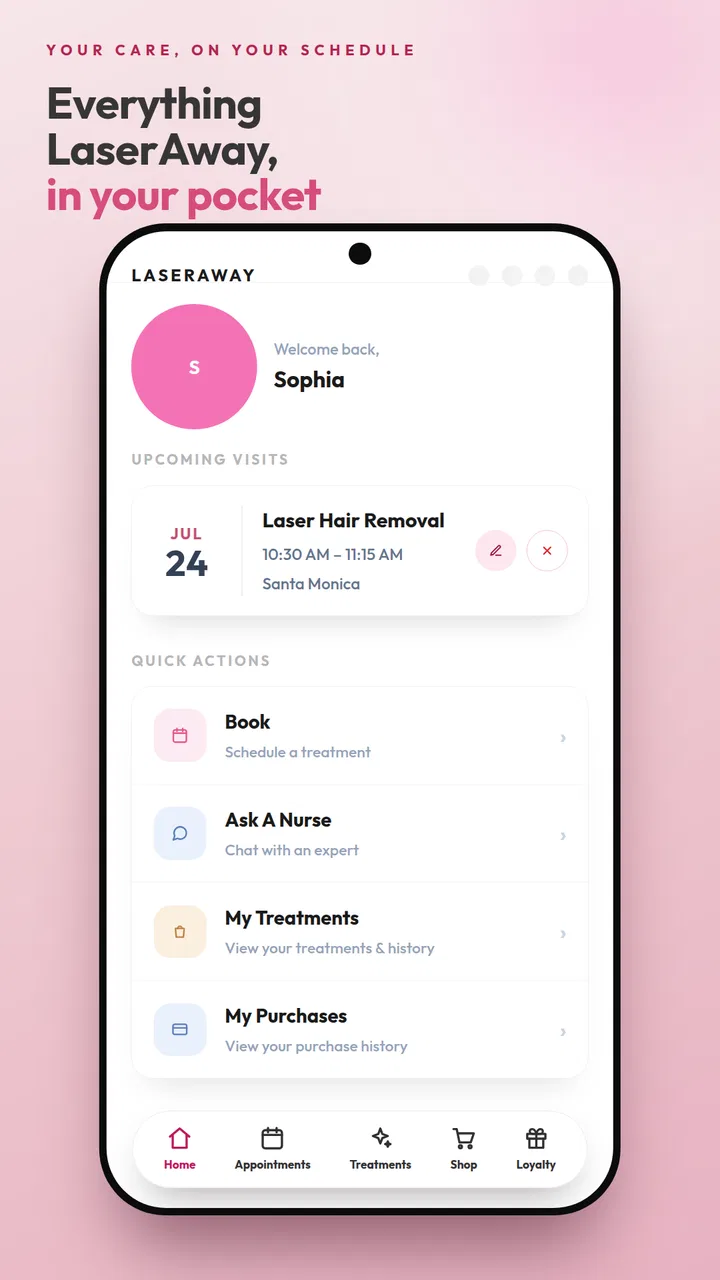
Yes, the LaserAway app includes a feature that allows users to schedule appointments at their nearest LaserAway clinic. The app provides a seamless booking interface, letting users choose their preferred services, dates, and times with ease.
04Is my personal information secure in the LaserAway app?
LaserAway prioritizes user privacy and security. The app employs encryption and other security measures to protect users’ personal data. It’s important to review the app’s privacy policy to understand how your information is managed and stored.
05What devices are compatible with the LaserAway app?
The LaserAway app is compatible with most modern smartphones and tablets running on Android and iOS platforms. Ensure your device's operating system is updated to the latest version for optimal performance and access to all features offered by the app.
Pros
- User-friendly interface for easy navigation.
- Wide range of treatment options available.
- Booking appointments is quick and simple.
- Detailed information about each procedure.
- Loyalty rewards for frequent users.
Cons
- Limited availability in certain locations.
- Requires stable internet for booking.
- Some features need in-app purchases.
- Notifications can be overwhelming at times.
- Occasional app crashes reported by users.

LaserAway
Gallery